


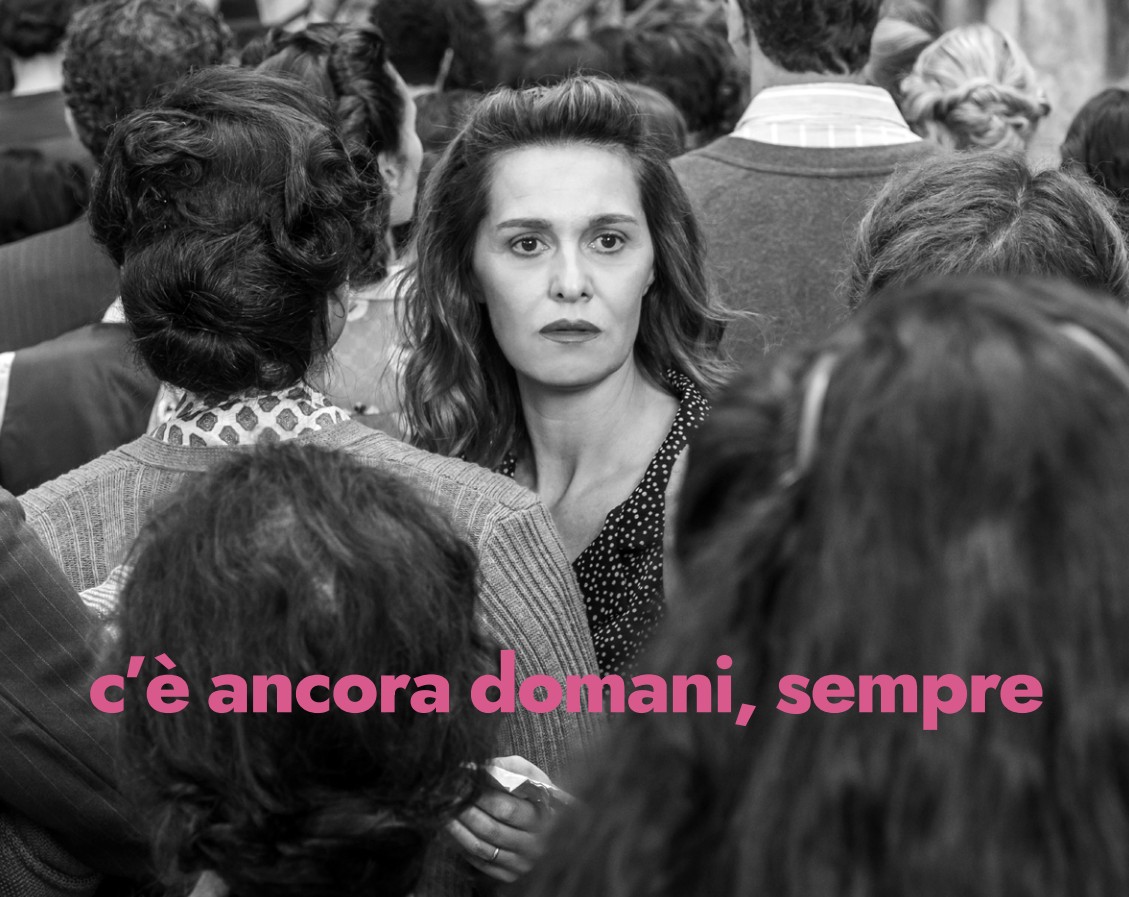
Starting Thursday, April 30 (opening at 6:30pm, in the presence of the author Claudio Iannone and the curator Alessandra Albanesi) through June 1, the Italian Cultural Institute of Miami presents the photography exhibition There Is Still Tomorrow, Always.
The exhibition features 50 photographs taken by Claudio Iannone during the filming of There Is Still Tomorrow (2023), directed by and starring Paola Cortellesi. The project aims to document, through still images from the set, some of the film’s most significant moments, offering insight into the creative process and the construction of its narrative.
Set in post-World War II Rome, There Is Still Tomorrow tells the story of Delia and her family, placing itself within the tradition of Italian neorealism, also through its use of black and white cinematography. The photographs on display convey the complexity of the characters and situations portrayed, alternating between moments of everyday life and scenes of greater dramatic intensity. As Paola Cortellesi has noted, Claudio Iannone’s images effectively capture the film’s emotional dimension, providing a visual testimony consistent with its cinematic language.
The initiative serves not only as an in-depth exploration of the movie, but also as an opportunity to reflect on socially relevant topics, including the role of women and the issue of gender-based violence.
Claudio Iannone has worked for the press offices of RAI, the Italian Swimming Federation, and the Italian Rugby Federation, also serving as chief photographer for the Italian Swimming Federation’s press office. He has collaborated with photographic agencies such as Trans World Press, Granata Press, and Photomovie. Since 1991, he has exclusively documented all movies sets by Gianni Amelio. In 2012, he worked exclusively for Melampo during Roberto Benigni’s theatrical tour “Tutto Dante.” As a set photographer, he has worked on more than 120 films, collaborating with numerous directors including Ettore Scola, Carlo Lizzani, Paola Cortellesi, Riccardo Milani, Francesca Archibugi, Antonio Albanese, Bille August, Gabriele Salvatores, Giovanni Veronesi, Roberto Benigni, and Sergio Rubini.