


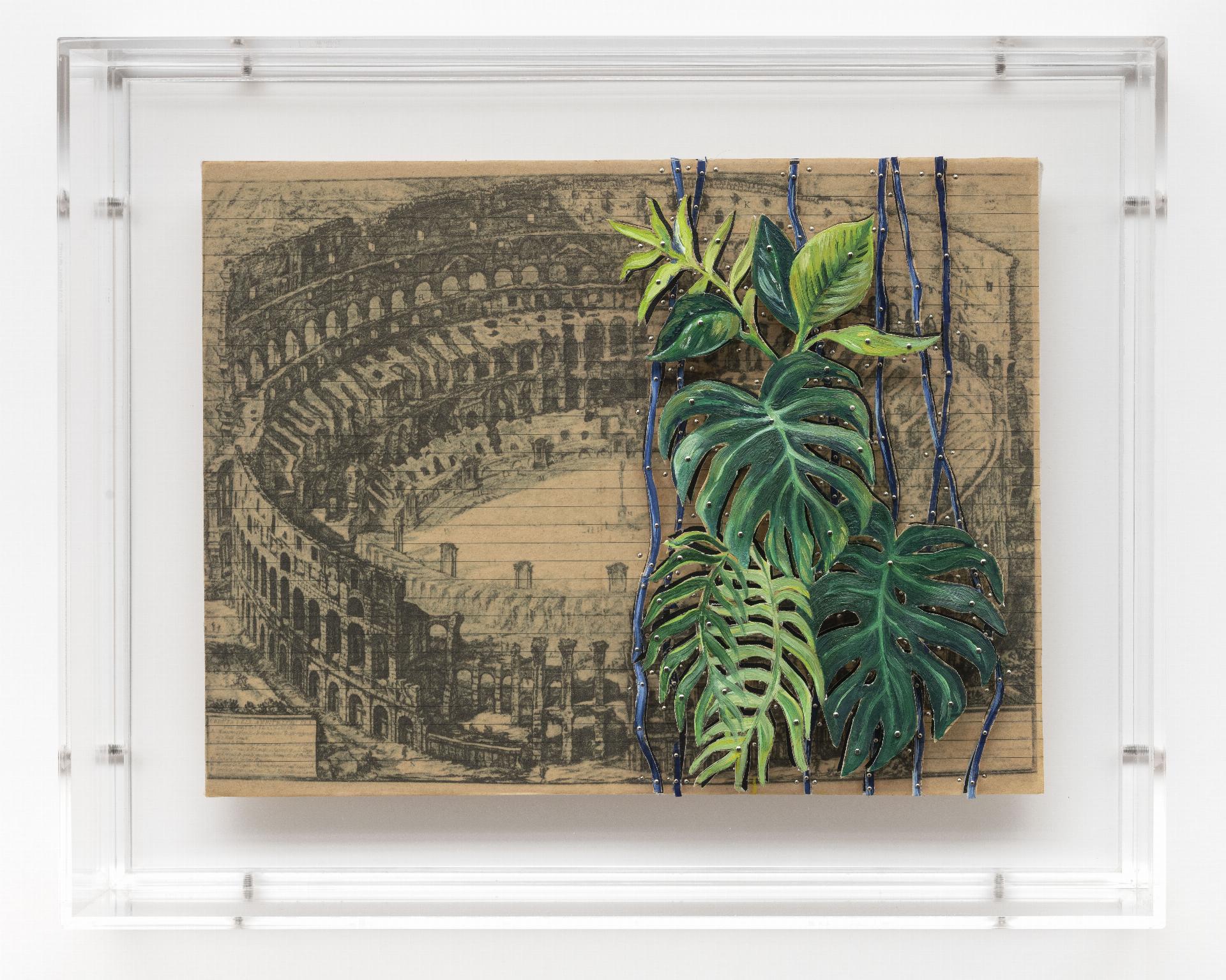
At the beginning of Miami Art Week, on Monday, November 30, at 7:00 PM, the Italian Cultural Institute in Miami will host the opening of AETERNA, a solo exhibition by artist Pietro Ruffo.
Through an extensive visual and conceptual journey, Ruffo invites visitors to reflect on the relationship between human beings, nature, and memory, exploring the different dimensions of time: from historical time, marked by events and the transformations of civilizations, to geological and cosmic time, which precedes the appearance of humankind and continues long beyond its existence.
Rome lies at the heart of the exhibition’s concept – a city where past and present intertwine through layers of architecture, landscapes, and traces of history. In Ruffo’s works, however, the Eternal City transcends its monumental image to reveal itself as a living organism, shaped by different temporalities, where the history of civilizations intertwines with the immensely older history of the planet.
The reference to the tradition of Roman views, and particularly to the imagery of Giovanni Battista Piranesi, is one of the starting points of Ruffo’s artistic research. While in eighteenth-century engravings ruins bear witness to both the grandeur and transience of human civilizations, Ruffo reinterprets this iconographic legacy by placing architectural structures within ever-changing natural environments. Vegetation, rocks, sedimentation, and imaginary landscapes enter into dialogue with historical traces, transforming our perception of space and time. Rome, with its extraordinary density of memories, thus becomes a paradigm of a universal condition. As the artist seems to suggest, inhabiting the world does not mean possessing it, but rather participating, for an infinitesimal moment, in its continuous transformation.
Through works from several different series, the exhibition explores the distinction between historical memory and the memory of matter. The former is constructed through documents, images, and narratives; the latter emerges through the physical and biological processes that shape the natural world. Rocks, plant forms, and architecture become witnesses to a continuity in which preservation and transformation are inseparable dimensions.
Particularly significant is the “Antropocene” series, in which Rome appears immersed in primordial landscapes or in possible future configurations of the planet. Lush forests, submerged landscapes, and vegetation reclaiming architectural spaces form an imaginary geography in which chronological distances seem to dissolve. The works dedicated to the Flavian Amphitheatre also draw inspiration from nineteenth-century studies by botanist Richard Deakin on the spontaneous flora of the Colosseum, restoring an unexpected dimension to the ruins: not merely a testament to a past civilization, but an ecosystem where the memory of architecture coexists with new forms of life.
A further development of this research emerges in “The Planetary Garden,” a project inspired by the ideas of landscape architect Gilles Clément and his conception of Earth as one vast garden, shaped by the continuous exchange and migration of species. The environmental dimension of the work invites viewers to move beyond the boundaries of representation and recognize themselves as part of a living system. It challenges an anthropocentric vision of the world while highlighting the profound interdependence between human existence and the planet’s ecological balance.
Born in Rome in 1978, Pietro Ruffo lives and works in the Italian capital. After earning a degree in Architecture from Roma Tre University, he received the Cairo Prize in 2009 and the New York Prize in 2010, the same year in which he was awarded a research fellowship at the Italian Academy for Advanced Studies at Columbia University.
Throughout his career, Ruffo has exhibited at prestigious international museums and cultural institutions, including the Venice Biennale, Palazzo delle Esposizioni in Rome, the Vatican Museums, Galleria Borghese, MAXXI – National Museum of 21st Century Arts, the National Gallery of Modern and Contemporary Art, and Triennale Milano. His works are part of important public and private collections, including those of the Vatican Museums, MAXXI, and the Farnesina Collection of the Italian Ministry of Foreign Affairs and International Cooperation.
In recent years, his artistic research has further expanded through major public commissions and large-scale urban interventions. Between 2024 and 2026, he created a permanent artwork for the 80th anniversary of the Italian Republic at Palazzo Montecitorio, a site-specific installation for the Quirinal Palace Library, a 640-square-meter mural in Piazza Venezia in Rome, a large-scale installation for the 60th Venice Biennale, and a series of works for Expo 2025 in Osaka, Japan.
AETERNA invites visitors to look beyond the boundaries of human history and rediscover, through art, the complexity and wonder of the world we inhabit. The exhibition will remain on view through January 22, 2027.
The artist and curator Micol Di Veroli will be present at the opening.
To learn more about the artist’s work, visit his website or follow him on Instagram: @pietroruffoartist.
Free admission. Reservations required by email: iicmiami.segreteria@esteri.it